Recently I was able to complete the repair of a genuine "Monster." Two-channel 750W RMS each. Stuff to festival, as they say in my part.
The patient in question, as the title, an amplifier of DAP Audio Palladium Model 2000 "Vintage". I had already heard of the DAP, with regard to professional power equipment, and in fact the module in question has all the features of the case and is mounted in the rack.
But let's go. The owner of the amplifier, an acquaintance of mine who owns an audio-video service, told me about the dilemma on a night, the right channel was blown improssivamente, and gave the panel "in protection." Amplifier open, you immediately noticed the fuses 12A burned.
The replacement of the same caused the melting of the fuses again, a sign indicative of a short circuit quite dry. The amplifier open
:
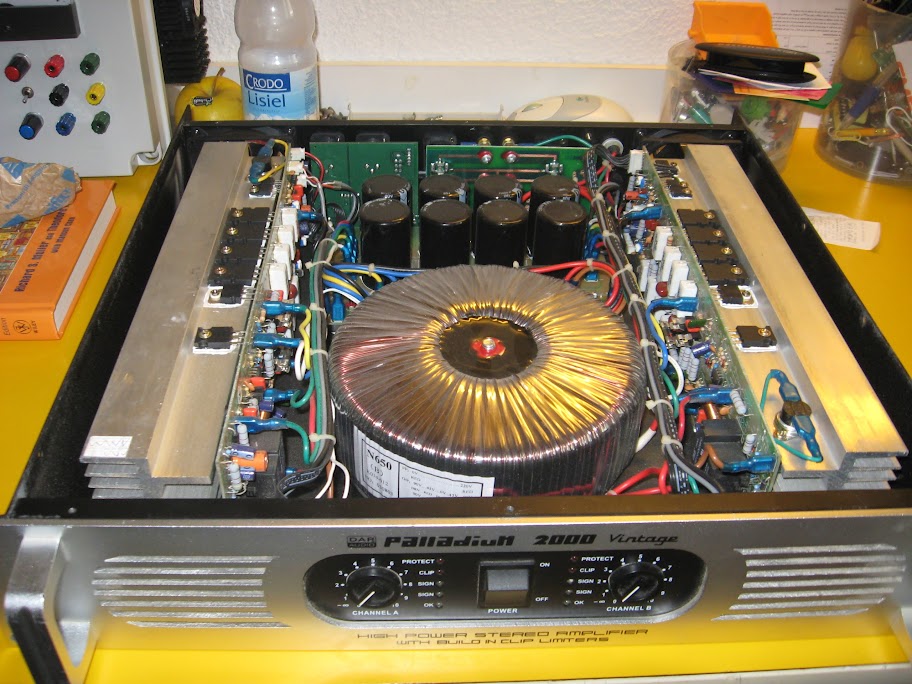
As soon as I heard the description of the fault, I did give the amp to have a look, thinking quickly to a short dry in the final stage, a problem quite common in amplifiers Class AB; certainly did not expect an ending so powerful.
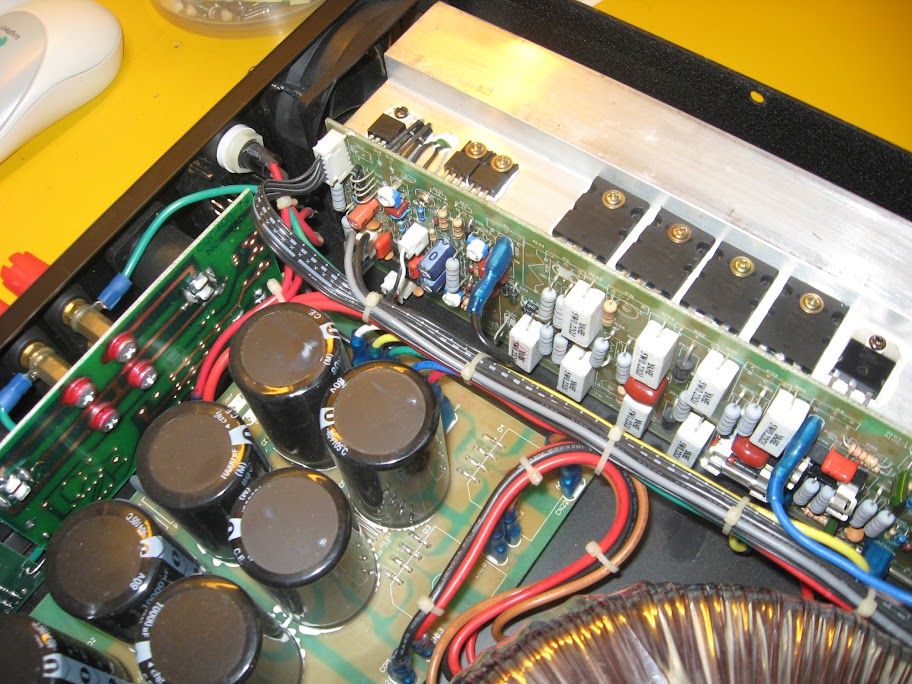
Four pairs (per channel!) 2SA1943-2SC5200 transistors complementary, couple that I found to be widely used in audio.
The transistors:
The discovery of the fault
I then removed the damaged module on the channel, marking the layout of the wiring (there are several, at least fifteen Faston connectors, power cords with a silicone sheath, a real delicacy). By measuring with the tester gently
the presence of shorts, I noticed the short dry downstream of the fuses, almost certainly due to some transistors in the final went the full circuit.
The only way to ensure that this was unsolder all the endings, and check them one by one.
The private channel heat sink, the transistor should be noted:
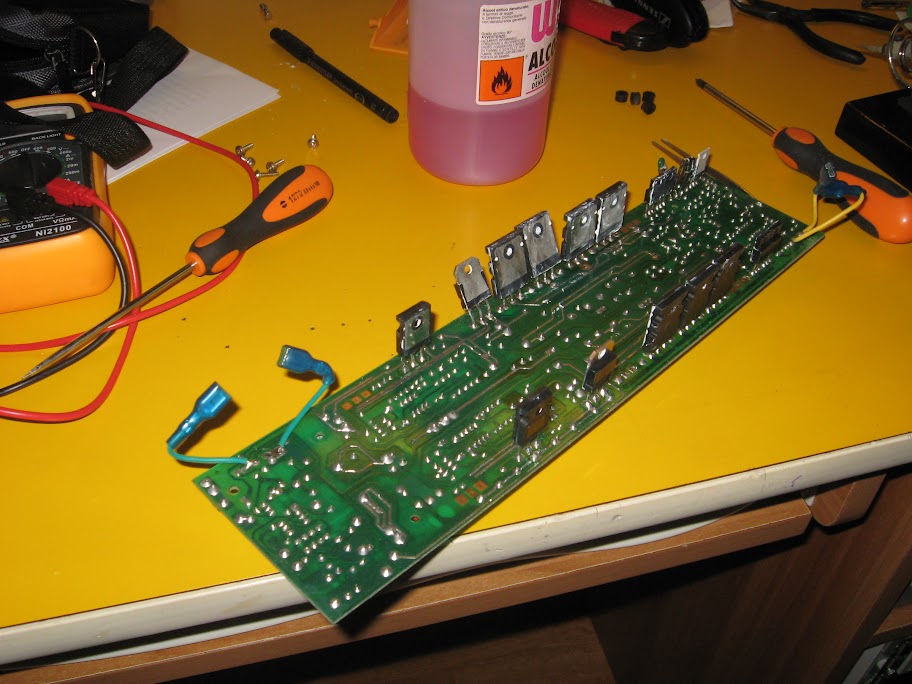
In fact, after a simple measure of continuity tester, I found a shorted 2SC5200 and 2SA1943 dry. I felt that the only cause of failure were the two transistor amplifier, and proof of what I resolder the remaining working, I reinstalled the whole thoroughly, and the final work again!
In my opinion, the transistors are blown to overheating, and you may at first only one of them is gone short circuit, the potential tying the output power (positive or negative), leading to clear the merger of one of transistor of the opposite line. This chain reaction has caused a short circuit at full power, which melted the fuse and stopped the imminent complete destruction of the finale.
For the first experiments I used cautiously fuses by 3.15 A.
The problem of transistor
The problem at this point was to find new 2SA1943 and 2SC5200.
suppliers via the internet is better not to speak, I found sites very "shady" with shipping very smoky, and sites that did not send until my next order (I do not do names for obvious reasons, but because they have only lost long time and obtained more discourteous responses)!
short, if one needs a 2SA1943 and 2SC5200 can not have them, unless you pay them in rough diamonds or gold. Apart from jokes, I was genuinely appalled by the difficulty of find these transistors.
solution
Luckily I came back to mind the one who gave me the TDA1514 unavailable for the Linn Majik (see previous posts).
After a brief exchange of mail (which I also explained the trick is to read the code of "rank" to identify the range of gain hfe of the transistor), my "supplier" has got to go to Beijing (sic ) and find a pair of transistors exactly the same as mine.
In fact, the alternatives were searching for transistor rank "or", or the replacement of all transistors to ensure the proper balance of earnings, but the amount to be spent would be much higher. And then it was a pity 6 fully functional transistor unsolder and original because of two burnt.
Reconstruction ...
I then received the two new transistor, but before I had to assemble and disassemble and clean the sink all transistors attached to his body, since the thermal paste had dried easily during disassembly, and possible reuse of the same could seriously endanger the integrity of the amplifier.
In fact, the common "white dough" is not reusable because of dry (it takes just once air) produces the exact opposite effect to the warming, which isolates the transistors from the heat sink, causing, cone is imagine, the rupture due to overheating.
The probable cause of the failure
After cleaning with alcohol the sink, I noticed the details that made me seriously doubt the build quality of this amplifier.
The aluminum heat sink was particularly rough, you could see some holes and flared badly redone, a glaring sign of a machine tool that had lined aluminum own at the final transistors, evidently no one had thought to sand the area so sensitive, and insisted that the chemical transistors on an area full of valleys and burrs!
I then proceeded to rub the sensitive areas with fine sandpaper, eliminating any surface irregularities and ensuring a more dignified end to a 750W. I find it very strange that no effect was found of such basic quality standards.
The question has become even more fierce when I observed the thermal coupling of a pair of diodes and a thermistor. The diodes are simply supported aluminum, and held together by a thick layer of white paste, and the thermistor is literally "drowned" in a valley filled with the same dough.
Needless to say that with time the dough will dry up, and changes in temperature sensitive components such as diodes and a thermistor will work badly.
Anyway, I reassembled everything exactly "as it was before," without making any changes.
The amplifier is playing very well on my desk, but is driving the speaker 15W, so it's essentially "resting." As soon as possible will be delivered to its rightful owner, and I hope to be able to hear during testing at full power!
Soon more pictures of their work.
As always, the photos are visible in high resolution on PICASA
Once again, THANK Maurizio!


